
Activation Functions & Initialization
Progress — 0/5 tasks
Activation Functions & Initialization — Student Lab
Focus: implement activations + init schemes and empirically verify signal/gradient propagation across depth.
Section 0 — Setup
We’ll work with synthetic Gaussian inputs so we can isolate activation/init effects.
Activations
Section 1 — Activations
Task 1.1
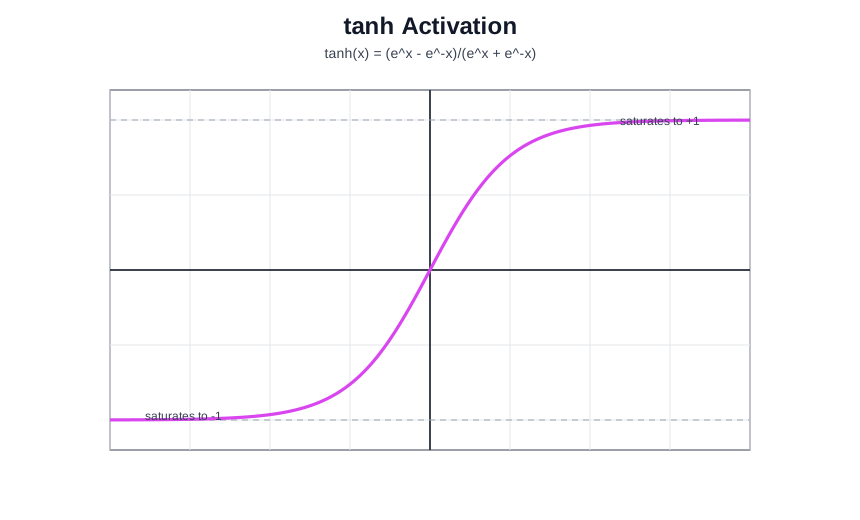
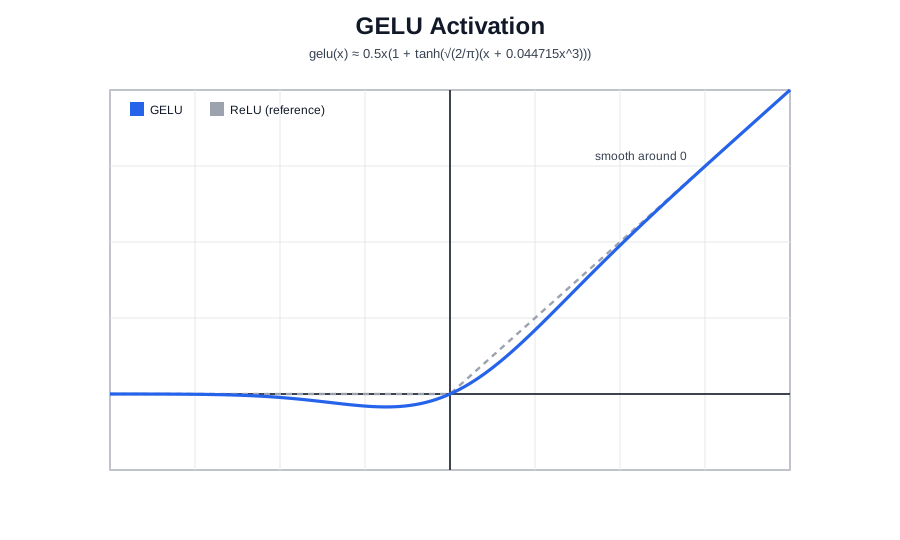
Implement ReLU, tanh, and GELU (approx).
Task 1.2
Compare output mean/std on standard normal input.
Optional concept — Softplus
softplus(v) = log(1 + e^v)
Why it is used:
- ●smooth approximation of ReLU
- ●avoids numerical instability with a stable implementation
- ●useful in logistic-loss derivations
Behavior:
- ●if
vis very large positive,log(1 + e^v) ≈ v - ●if
vis very large negative,log(1 + e^v) ≈ 0
So Softplus behaves like max(0, v) but smoothly.
Initialization schemes
Section 2 — Initialization schemes
We’ll initialize weight matrices for a linear layer: Y = X W (no bias).
Task 2.1
Implement:
- ●naive normal init with std=1
- ●Xavier normal init
- ●He normal init
Return a weight matrix of shape (fan_in, fan_out).
Forward signal propagation across depth
Section 3 — Forward signal propagation across depth
We simulate an L-layer network: X_{l+1} = act(X_l W_l)
Task 3.1
Write simulate_forward(X0, L, init_fn, act_fn) returning stats per layer.
We care about:
- ●mean/std of activations
- ●for ReLU: fraction of zeros
- ●for tanh: saturation (
|a| > 0.95) and average local derivative
Task 3.2
Compare naive vs Xavier/He for depth L=50 using both ReLU and tanh.
Backward gradient propagation (toy)
Section 4 — Backward gradient propagation (toy)
We estimate gradient flow using a simple scalar loss:
- ●Forward: X_{l+1} = act(X_l W_l)
- ●Loss: mean(X_L)
- ●Backward (approx): propagate gradients using local Jacobians
This is not a full autodiff engine; it’s a controlled experiment to see gradient norms explode/vanish.
Task 4.1
Implement activation derivatives for ReLU and tanh.
Task 4.2
Simulate gradient norms across depth for different init schemes.